

1.1 Asexual reproduction
In this method, a single individual (parent) is capable of producing offspring. As a result, the offspring that are produced are not only identical to one another but are also exact copies of their parent. Are these offspring likely to be genetically identical or different? The term clone is used to describe such morphologically and genetically similar individuals.
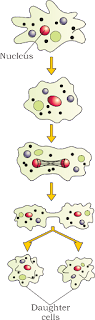
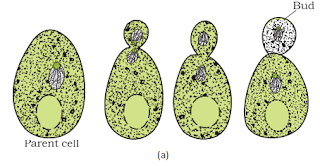
Figure 1.2 Cell division in unicellular organism: (a) Budding in yeast; (b) Binary fission in Amoeba
Let us see how widespread asexual reproduction is, among different groups of organisms. Asexual reproduction is common among single-celled organisms, and in plants and animals with relatively simple organisations. In Protists and Monerans, the organism or the parent cell divides by mitosis into two to give rise to new individuals (Figure1.2). Thus, in these organisms cell division is itself a mode of reproduction.
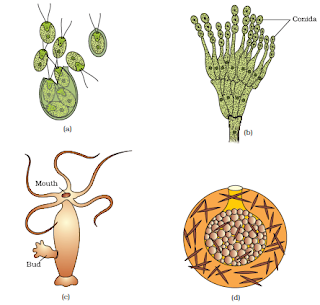
Figure1.3 Asexual reproductive structures: (a) Zoospores of Chlamydomonas; (b) Conidia of Penicillium; (c) Buds in Hydra ; (d) Gemmules in sponge
Many single-celled organisms reproduce by binary fission, where a cell divides into two halves and each rapidly grows into an adult (e.g., Amoeba, Paramecium). In yeast, the division is unequal and small buds are produced that remain attached initially to the parent cell which, eventually gets separated and mature into new yeast organisms (cells). Under unfavourable condition the Amoeba withdraws its pseudopodia and secretes a three-layered hard covering or cyst around itself. This phenomenon is termed as encystation. When favourable conditions return, the encysted Amoeba divides by multiple fission and produces many minute amoeba or pseudopodiospores; the cyst wall bursts out, and the spores are liberated in the surrounding medium to grow up into many amoebae. This phenomenon is known as sporulation.
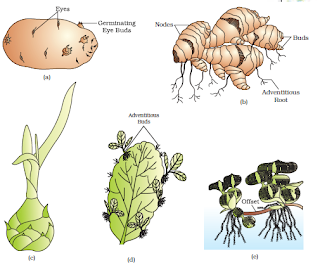
Figure 1.4 Vegetative propagules in angiosperms: (a) Eyes of potato; (b) Rhizome of ginger; (c) Bulbil of Agave; (d) Leaf buds of Bryophyllum; (e) Offset of water hyacinth
Members of the Kingdom Fungi and simple plants such as algae reproduce through special asexual reproductive structures (Figure 1.3). The most common of these structures are zoospores that usually are microscopic motile structures. Other common asexual reproductive structures are conidia (Penicillium), buds (Hydra) and gemmules (sponge).
You have learnt about vegetative reproduction in plants in Class XI. What do you think – Is vegetative reproduction also a type of asexual reproduction? Why do you say so? Is the term clone applicable to the offspring formed by vegetative reproduction?
While in animals and other simple organisms the term asexual is used unambiguously, in plants, the term vegetative reproduction is frequently used. In plants, the units of vegetative propagation such as runner, rhizome, sucker, tuber, offset, bulb are all capable of giving rise to new offspring (Figure1.4). These structures are called vegetative propagules.
Obviously, since the formation of these structures does not involve two parents, the process involved is asexual. In some organisms, if the body breaks into distinct pieces (fragments) each fragment grows into an adult capable of producing offspring (e.g., Hydra). This is also a mode of asexual reproduction called fragmentation.
You must have heard about the scourge of the water bodies or about the ‘terror of Bengal’. This is nothing but the aquatic plant ‘water hyacinth’ which is one of the most invasive weeds found growing wherever there is standing water. It drains oxygen from the water, which leads to death of fishes. You will learn more about it in Chapters 13 and 14. You may find it interesting to know that this plant was introduced in India because of its beautiful flowers and shape of leaves. Since it can propagate vegetatively at a phenomenal rate and spread all over the water body in a short period of time, it is very difficult to get rid off them.
Are you aware how plants like potato, sugarcane, banana, ginger, dahlia are cultivated? Have you seen small plants emerging from the buds (called eyes) of the potato tuber, from the rhizomes of banana and ginger? When you carefully try to determine the site of origin of the new plantlets in the plants listed above, you will notice that they invariably arise from the nodes present in the modified stems of these plants. When the nodes come in contact with damp soil or water, they produce roots and new plants. Similarly, adventitious buds arise from the notches present at margins of leaves of Bryophyllum. This ability is fully exploited by gardeners and farmers for commercial propagation of such plants.
It is interesting to note that asexual reproduction is the common method
of reproduction in organisms that have a relatively simple
organisation, like algae and fungi and that they shift to sexual method
of reproduction just before the onset of adverse conditions. Find out
how sexual reproduction enables these organisms to survive during
unfavourable conditions? Why is sexual reproduction favoured under such
conditions? Asexual (vegetative) as well as sexual modes of reproduction
are exhibited by the higher plants. On the other hand, only sexual mode
of reproduction is present in most of the animals.

Learn Social Science Contemporary India
Learn India and the Contemporary World-II
Learn Understanding Economics Development
Learn Health and Physical Education


No comments:
Post a Comment